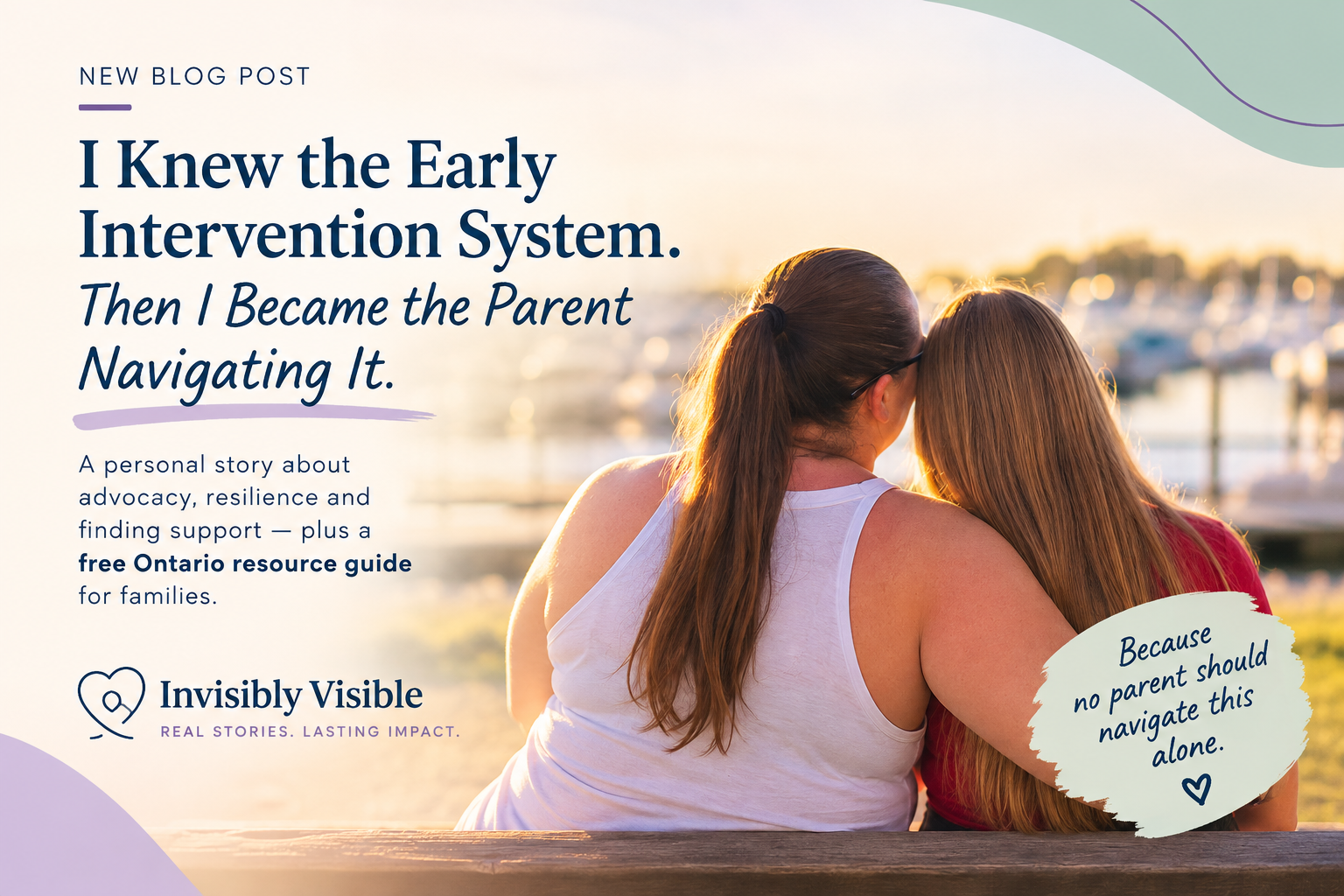
When professional knowledge meets personal experience, you discover that knowing the system doesn't necessarily make navigating it any easier.
I spent years helping families navigate developmental concerns, referrals, and early intervention services. I knew the programs, understood the importance of early support, and recognized the challenges families faced when trying to access services.
Yet when my own daughter needed that same support, I discovered just how overwhelming the system could be—even when you know how it works.
And perhaps the hardest part wasn't understanding what needed to happen next. It was realizing that, despite doing everything I knew to do, I still felt like I was failing her.
My career working with children and families began at a summer camp as a leader-in-training. Later, I spent a summer working as an Early Childhood Assistant in a child care program supporting teen mothers. Ironically, I was the same age as many of the moms.
That experience confirmed something I already felt strongly about: I wanted to work with children and families, particularly those who needed additional support.
Working collaboratively with Family and Children's Services gave me a deeper understanding of the challenges families face. It sparked a passion that eventually led me beyond early childhood education and into early intervention.
Over the years, I worked as an Intensive Behaviour Interventionist with Hamilton Health Sciences, followed by roles as a Resource Consultant and Infant Development Consultant with HN REACH and Niagara Region Public Health.
I spent my professional life supporting families, identifying developmental concerns, connecting parents with resources, and advocating for early intervention.
Then my professional world and personal life collided.
My youngest daughter, Olivia, began experiencing developmental delays and significant health concerns.
I was determined that she wouldn't fall through the cracks.
I had seen too many families told to "wait and see," unaware of available programs or left waiting for referrals without knowing what they could do in the meantime.
So, I did what I knew.
We attended EarlyON programs, accessed lactation consultants, and pursued referrals to a dietitian, occupational therapist, and pediatrician.
By four months old, Olivia had an entire team monitoring her health and supporting her development.
Yet somehow, it still didn't feel like enough.
I knew there was something more happening beneath the surface. Her failure to thrive wasn't simply a matter of being a fussy baby. She was experiencing real pain, discomfort, and fear.
And despite all the professional knowledge I had accumulated, I couldn't make it better.
That feeling of helplessness was something no amount of education or experience could have prepared me for.
When Early Intervention Becomes a Full-Time Job
As Olivia's needs became more complex, so did her care team.
Speech therapists, occupational therapists, physical therapists, dietitians, and infant development specialists became part of our lives. Alongside them were pediatricians, an ENT specialist, a gastroenterologist, a geneticist, nurse practitioners, a personal support worker, and, of course, us—her parents.
When you understand the critical role early intervention can play in a child's development, you dive in headfirst.
You attend the appointments. You follow the recommendations. You practise the strategies. You make the phone calls and follow up on referrals.
What you don't necessarily anticipate is how exhausting it becomes to coordinate it all.
Managing Olivia's appointments and services quickly became a full-time responsibility for our family, on top of raising two other children and working full time.
We eventually decided that Corey would stay home while I returned to work.
On paper, it seemed like the most logical decision, as I was full time and had benefits and a pension.
But living it was something entirely different.
Working in the same field meant there was no real separation between my professional responsibilities and our family's reality.
I would spend my workday supporting families through developmental concerns, behavioural outbursts, social challenges and then return home to those very same experiences.
And something changed in how I understood the families I served.
I understood the parent who struggled to squeeze one more appointment into an already overwhelming week.
I understood the exhaustion of celebrating the smallest amount of progress while quietly wondering when things might get easier.
I even remember feeling envious when another child could manage a few teaspoons of baby food because, at that moment, even that felt like progress we desperately wanted as Olivia was exclusively fed through her G-tube.
I understood the parents who hadn't found time to wash their hair, who threw a hoodie over their pajamas, and who left yet another cold cup of coffee sitting on the counter.
Because I was that parent, too.
Having my own child with complex needs gave me a different kind of understanding—one that couldn't be learned through professional training alone.
The families I supported saw themselves in me, and I saw myself in them.
We exchanged stories about long waits at the McMaster emergency department. I shared information about Ronald McDonald House and the importance of finding opportunities to rest and recharge during hospital visits.
Our conversations became more than discussions about developmental milestones and service recommendations.
They became moments of genuine connection.
But there was another realization unfolding.
After years of witnessing families experience ongoing challenges, systemic frustration, and uncertainty, I began to understand that this might not be a temporary chapter in our lives.
Some challenges would improve. Others might remain.
And while every child and family has unique strengths, exhaustion can make it difficult to see beyond the moment you're living in.
At the time, I couldn't imagine what life outside survival mode would look like.
The Reality Behind Invisible Disabilities
Today, I can say that our family has reached a place of greater stability.
Getting here required perseverance, patience, advocacy, and an enormous amount of grace—for Olivia, for each other, and for ourselves.
But stability doesn't mean the challenges have disappeared.
One of the common misconceptions surrounding invisible disabilities is the assumption that if someone looks well, their struggles must be resolved.
Olivia can participate in school, activities, and experiences that once felt uncertain.
She can have conversations, smile in photographs, and enjoy many of the everyday moments that other families may take for granted.
From the outside, it might appear that the hardest parts are behind us.
And in many ways, we've made tremendous progress.
But progress does not mean cured.
Olivia's underlying genetic condition remains part of her life. Her social and self-regulation challenges don't disappear simply because they're less visible to others.
Many milestones that developed naturally for other children required intentional practice, repetition, support, and patience for Olivia.
There were countless hours of therapy, appointments, advocacy, and everyday opportunities to build skills.
The progress people see today didn't happen overnight.
It represents years of effort, much of which happened quietly, behind the scenes.
And while I celebrate how far she has come, it can be disheartening when others assume her disability no longer exists simply because she appears to be doing well.
This is part of what inspired Invisibly Visible.
Because so much of what families experience isn't visible to the outside world.
The appointments, the emotional exhaustion, the advocacy, the uncertainty, and the constant effort required to support a child can remain hidden behind an ordinary-looking day.
What Families Can Do While Waiting for Support
Early intervention can play an important role in supporting children with developmental concerns.
But accessing those services isn't always straightforward.
Families may spend months waiting for assessments, referrals, therapy appointments, or specialist consultations.
And during that time, parents are often left wondering:
Am I doing enough?
Should I be pushing harder for answers?
What if we're missing an important opportunity to help our child?
What can I actually do while we're waiting?
I understand those questions because I've asked them myself.
Early intervention also doesn't end when the appointment does.
Many of the strategies families learn become part of everyday routines—sometimes through intentional practice and sometimes through the simplest moments of play, connection, and daily life.
But parents need realistic guidance, resources, and support to make that possible.
Families shouldn't be expected to become experts in every aspect of their child's development, nor should they feel responsible for overcoming every limitation of the systems around them.
Yet too often, parents find themselves acting as the main coordinators of their child's care.
They follow up on referrals, communicate between providers, manage waitlists, organize appointments, and try to make sense of recommendations from multiple professionals.
And when specialists and service providers operate independently, important information can become fragmented.
For families without a primary care provider, accessing referrals and coordinating services can be even more challenging.
Searching online may seem like the obvious solution, but sorting through overwhelming amounts of information to find reliable, relevant, and current resources is another task added to an already full plate.
I know this because, despite my professional experience, I had to learn how to advocate more effectively for Olivia, follow up consistently with her multidisciplinary team, and ensure she was placed on the appropriate waitlists.
Knowing the system helped.
But it didn't remove the uncertainty, exhaustion, or emotional weight of navigating it.
And that made me think about all the families starting this journey without the professional background or connections I had.
Why I Created the Waiting Room Roadmap
If navigating the early intervention system was overwhelming for me with my professional knowledge, experience, and understanding of available programs—what must it feel like for a parent who doesn't know where to begin?
That question stayed with me.
It also brought me back to the families I had worked with throughout my career.
The parents who knew something wasn't quite right but didn't know whom to call.
The families who were waiting for assessments without understanding what other supports might be available.
The caregivers who were exhausted from searching for answers while trying to manage everyday life.
I wanted to create something practical that could help families feel a little less lost during that waiting period.
That's why I created The Watch and Wait Roadmap: Navigating Developmental Concerns in Ontario, a free resource for Ontario families navigating developmental concerns, referrals, waitlists, and early intervention services.
The guide brings together practical checklists, questions to consider, and Ontario-specific resources to help families identify possible next steps.
It isn't intended to replace professional assessment or individualized medical and developmental advice.
Instead, it's a starting point.
Something to help you organize your thoughts, prepare for conversations with professionals, explore available supports, and feel more informed while waiting for answers.
Because being told to wait shouldn't mean being left without direction.
Waiting for Answers? You Don't Have to Navigate It Alone.
If you're an Ontario parent navigating developmental concerns, referrals, or waitlists, I created this free guide with you in mind.
The Roadmap includes:
Practical checklists to help organize information and next steps.
Questions to consider when speaking with healthcare and developmental professionals.
Ontario-specific programs and resources to explore.
Guidance to help you feel more prepared and informed throughout the process.
Get Your Free Watch and Wait Roadmap
You Are Not Invisible
Looking back, I realize that my professional experience gave me knowledge, but becoming Olivia's mom gave me an entirely different perspective.
I learned that advocacy is exhausting, progress isn't always linear, and even when you're doing everything you can, there will be moments when you question whether it's enough.
I also learned that families need more than referrals, appointments, and professional recommendations.
They need understanding.
They need connection.
They need to know that someone recognizes the invisible work they're doing every single day.
If you're navigating this journey right now, I want you to know something.
I see you. I hear you. You are not invisible, and neither is your child.
I hope this resource offers a little more direction, a little less uncertainty, and the reassurance that you don't have to figure everything out alone.
Warmly,
Alison
Creator of Invisibly Visible

Come along for the journey.
Through the Invisibly Visible podcast and blog, I share honest conversations about parenting, caregiving, advocacy, and the experiences that often go unseen.
Listen wherever you get your podcasts, explore the stories on the blog, and join the IV League—where you're not just a listener, you're part of a community we're building together.
